
Story Hour
Nickazoo!
Written by Gene B. Williams
|
Click here for the archive page with a list of previous stories. Please remember that all materials on this website are copyrighted. No reproduction without express permission. |
|
The sound it makes is funny. Even the name is funny.
KAZOO!
It could be something a magician says when he makes a rabbit disappear.
KAZOO!
January 28 is National Kazoo Day. Do you have a kazoo? Maybe you can get one for Kazoo Day? Oh, even better … how about a kazoo party? Imagine a party with you and … oh, say, 35,721 of your best friends (just a small party) … all playing kazoos.
Danny and Nicker learned to play a kazoo. (Take it from me, they are pretty good at it!) Of course, they had special help from a special friend, Captain Kazoo. Captain Kazoo drives around in his Kazoo Mobile. Maybe you have seen him on TV, or in the movies? He has the world’s largest kazoo museum. And YOU can visit it right here. (Be sure to tell them that Nicker sent you.) All the photos here are brought to you by Captain Kazoo.
What IS a kazoo?
Have you ever put a blade of grass or reed between your thumbs to blow and make a sound? It takes a little practice, but you can make an amazing noise. This same idea is used for instruments like the clarinet, saxophone and oboe (and many others). These also use a reed, which is often a sliver of bamboo. The idea is the same. If you blow on it just right, it vibrates (wiggles real fast) like crazy, and that makes a sound.
Another simple instrument is a hollow tube. It can be wood, bone, a pipe … pretty much anything you have or want. If you just blow into it, not much happens. But if you blow into it in a way that your lips vibrate (wiggle real fast), you can make some great sounds! Instruments like the trumpet, trombone and French horn (and many others) do this, and make all the different notes from how that vibrating air moves around inside.
The kazoo … well, the kazoo kinda does both at the same time (but not really).
It’s a tube – but it doesn’t have to be round – and it has something that vibrates – the fancy word for it is membrane. Just blowing into it doesn’t do much. But, if you hum into it, that membrane vibrates.
The most common kazoo is round on one end, sorta flat on the other, with a round thing coming off one side. Inside that round thing is the membrane. When you hum into the kazoo (the flat end), that membrane vibrates. It buzzes. With just a little practice, you can make it buzz to nearly any note you can hum.
There are even different sizes. The most common is the soprano kazoo. It makes a higher sound, like a flute. The alto kazoo sounds more like a clarinet or trumpet. The tenor kazoo is more like a saxophone, and the baritone kazoo sounds more like a French horn. There is even the “Kaboom Kazoo” to sound like a tuba!
 |
 |
The most common kazoo these days is made of plastic. Metal kazoos are still around, and most have that same “submarine” shape. You hum into the larger flat end and the sound comes out the round hole at the other end.
 |
 |
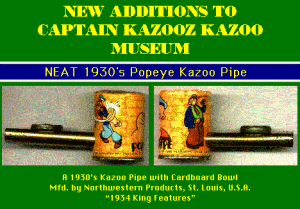
It doesn’t have to be this shape. Here are two very old kazoos. Others were made with all sorts of shapes. Many had cartoon characters, like Popeye, Scooby-Do, Mickey Mouse and many others.
 |
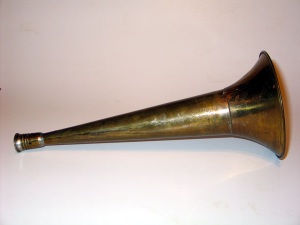 |
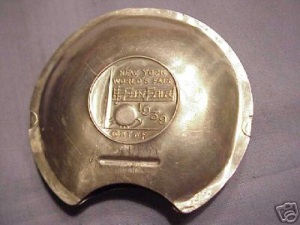
At the 1939 World’s Fair, lots of places had kazoos. Some looked like the tall buildings at the Fair. This one was made to be round. The logo of the 1939 World’s Fair was stamped into the metal. McDonald’s used this same idea for a while and had a kazoo that looked like a hamburger. The other may look like a horn. It’s called a zobo.
 |
 |
Kazoos can be made to look like almost anything – like a trumpet or a saxophone. One of my favorites is the “pipefitter” kazoo. When Captain Kazoo plays this, he pretends to be tuning it by turning the valve. I’ll let you in on a secret. He’s just changing how he hums. (You don’t tune a kazoo.)
All over the world, hollow tubes were used make sounds in lots of ways, for lots of reasons. Lots of different ways were used to make things vibrate for different sounds. Bones, gourds, bamboo … all sorts of things.
The most common story is that somewhere in Africa, some people discovered that dried spider-egg sacs could be used so that humming just right into a tube changed the sound. You could sound like someone else (or like no one). You could sound like an animal. In other places in the world, other people were doing sort of the same thing. We call this kind of instrument (one that buzzes) a mirliton. These were around in Europe from at least the 1600s. Maybe sooner.
Captain Kazoo told Nicker that someone named Alabama Vest took the idea to a German clock maker named Thaddeus Von Glegg and they made a kazoo. That was somewhere around 1840. A traveling salesman named Emil Sorg saw this, thought it would be something easy to sell. In New York, he joined with Michael McIntyre, a metal worker. This led to the first metal kazoo in 1912. (Hey, isn’t that the same year cotton candy was given to the public? And peanut butter? 1912 was a very busy year!!!)
Mass production began in 1914, and in 1916, The Original American Kazoo Company was formed. This company is still there, along with a really neat museum.
At first, it was treated as a real musical instrument. It became part of serious music, then later part of folk music. It fit in very well with bands that also used homemade instruments. You’ve probably blown into a bottle to make a whistling sound, but have you ever seen someone “play a jug?” Or a “wash tub bass fiddle?” Or, instead of a drum, use an old-fashioned washboard (with thimbles on the finger tips)? Jug bands are so fun. Here is just one place to go if you want to learn more about this.
(A Special FREE lesson from Captain Kazoo!)
It doesn’t take years to learn. I bet you can learn to play a kazoo in just a couple of minutes.
Captain Kazoo makes it very simple. “Don’t blow. Hum. That’s the biggest mistake. The other is, hum into the flat end, not the round end. That’s really all there is to it. Give it a try.”
He knows … and I know … and Nicker knows … you’ll learn very fast! In plenty of time for Danny’s and Nicker’s Birthday Bash.
Get your FREE Nicker Calendar page for February here. Circle February 8 in red (well … any color will do). That will be the birthday issue of Nicker Stories. I’m not really sure what will happen!

And circle February 12. That’s the actual Birthday Bash. I’m not really sure what will happen then, either – but we hope you will join in with us, and all the kids (okay, and the parents) all over the world.
Now come on over to Your Page and get some other FREE stuff.
Like this story?
Click here to see previous stories!
