
Story Hour
Lucky Penny
Written by Gene B. Williams
|
Click here for the archive page with a list of previous stories. Please remember that all materials on this website are copyrighted. No reproduction without express permission. |
Find a penny
Pick it up
All the day
You’ll have good luck
Penny, pence, pfennig, centavo and many other coins – the idea is the same. A unit of money, like the dollar, is divided into smaller parts. Believe it or not, there was a time when a dollar was a LOT of money! Many restaurants now have a “dollar menu.” Not all that long ago, you could get 20 hamburgers for that same dollar. Because the dollar was so big (worth a lot), there had to be a way to “make change.”
For a while in England, even a penny was too big. They had to have a quarter penny and a half penny. The penny was even cut into pieces because a whole penny was too much money.
These days, quite a few countries are getting rid of their smallest coins. One of the main reasons is that they cost more to make than they are worth. In America, it costs almost 2 cents to make 1 cent, and nearly a dime to make a nickel. And these days, you can’t get much for a penny. They often end up in a jar or cup. That means more pennies (and nickels) have to be made.
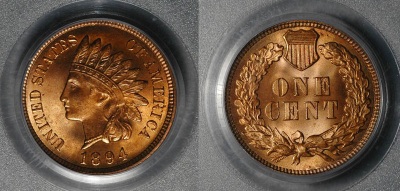
Worse, pennies today can be poisonous, especially to dogs and parrots. This is why ….
From 1793 to 1857, pennies were made from copper. From then until 1982, they were made from a blend of copper and other metals. Even with the lower amount of copper, by 1970 a penny was actually worth a penny for the copper it contained. Since 1982, the core of the penny has been made from zinc, and there is just a very tiny amount of copper on the outside.
If a modern penny (made after 1982) is swallowed, the zinc inside can cause serious health problems. It’s bad enough for humans, especially little children. It can easily kill dogs or parrots. They’re very sensitive to zinc poisoning.
We must all remember to keep any small objects, and especially pennies, out of the reach of animals and infants!
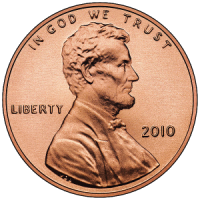
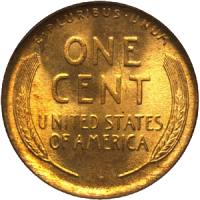
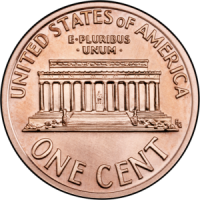
The Lincoln penny is the best known in America. The front (called the “obverse”) has the image of Abraham Lincoln. That is the design used since 1909. Until 1959, the back (called the “reverse”) had sheaves of wheat. Until recently, the reverse had the Lincoln Memorial. (Look closely and you’ll see the statue of Lincoln inside.) In 2010, the design was changed again. The reverse now has a shield with 13 stripes. Those represent the original 13 colonies that formed the United States.
 |
 |
 |
 |
When the idea of using a zinc core was being considered, also considered was making pennies from aluminum. There were some problems with that. One was that aluminum coins are very light. At the time there were machines that let you use pennies, such as to get a gumball. The aluminum pennies … well, they gummed up the gum machines. (They’d get stuck.)
Another problem also showed up. Do you know anyone who has ever swallowed a coin? I sure do. It’s a REALLY dumb idea, but kids in particular do it all the time (along with marbles, paper clips, pencil erasers … sheesh!). Even before the aluminum pennies were sent out to be used, it was found that they don’t show up on x-rays. In a serious emergency where the coin has to be removed fast and with surgery … the doctors couldn’t find where it was. (Aluminum pennies didn’t show very well on x-rays.)
Bye bye aluminum penny. Welcome zinc-core penny.
One day, maybe soon, the penny will disappear, and the nickel, too. If you want to get your own lucky penny … well, first something called “trivia.”
 |
 |
In London, England there is a large clock. It’s the largest of its kind in the world and is often called Big Ben. It works with a pendulum, which is a weight that swings back and forth. The pendulum for Big Ben is very big.
To keep the clock accurate, the pendulum is balanced with … guess what … pennies. Adding or taking away a penny changes the clock by about a half second per day.
By the way, Big Ben isn’t the clock, it’s the name of the large bell that chimes.
Now … here’s the fun, and the timing is actually pretty good. After all, this is Lucky Penny Day. As I said, quite a few countries no longer have small value coins. What a great time to get and keep one that you can give to your own children!
Find a penny that is stamped with the year you were born, then put it in a safe place. It can be your own special Lucky Penny for Lucky Penny day!
If you’re not in America, your own country will almost certainly have a similar coin. You can use one of these instead of a penny. (For that matter, wherever you live, you can use a coin from anywhere as your “lucky penny.” It might even be fun to have a foreign coin.)
While you’re looking for your own special coin, you can also learn about how money is made. There is a lot more going on in those designs than you might realize. Look at coins, and paper money, both front and back. See how much you can discover!
You know that Abraham Lincoln is on the front of the penny.
Who is that on the front of a nickel? (What is the front called?)
Who is on the front of a dime?
Who is on the front of a quarter?
What is on the back of a nickel?
What is on the back of a dime?
Before quarters were made for each state, what was on the back?
Remember, if you’re not in America, you have your own kinds of money. Don’t forget that money has been changing all this time. A penny made in 1910 isn’t at all like a penny made in 2010!
And … pssst … there are even more kinds of paper money than there are coins, with even more to see.
Like this story?
Click here to see previous stories!
