
Story Hour
Nicker Visits Marilou Marsh
by Gene B. Williams
Photos by Marilou
Art by (who else) MARCI!
Map by Mom and Dad
Cranberries by Marilou Marsh (and a few from Goose Landing)
Special Appearance by Maddy
Catering by Geno’s Magic Bread
Security by Gus and Gordie (supervised by Simon)
Voice Talent by Jason
Snow Angel by Gumby
Testing by the Edie Giggle Gauge
Technical Advisor Daniel Dumper Williams and Red Minute Web Design
Fish Stunts by Ernie
Reader (and artist) – YOU!
Enough credits!
|
Click here for the archive page with a list of previous stories. Please remember that all materials on this website are copyrighted. No reproduction without express permission. |
Note to the Parents: I hope you kept the maps out. Following the story is also something all about how cranberries are grown and harvested, plus some special links for even more fun!
You already know this. Nicker spent some time with his friend Tess in France, and you know what happened to his nose! (You don’t??? Click the Tess link and find out!) He had other adventures, of course, but you’ll have to wait for another day to hear those.Nicker was feeling lonely for home, and especially for Danny (and so am I). He got back in the river, swam and swam and swam across the big Atlantic Ocean until he came to America again. He was still a very long way from Arizona.
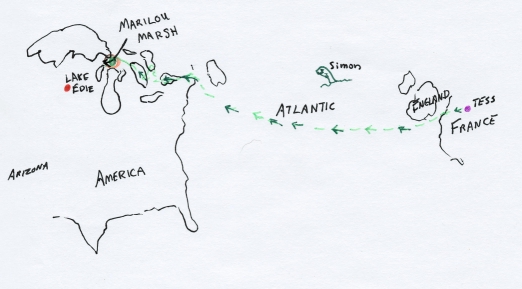
Lake Superior is where Danny fell into the water and yelled, “WOW, that water is COLD!” No, wait. That’s another story I haven’t told you yet. But you know about Minneapolis. That’s where Nicker went to Lake Edie and had trouble with a goose, and where he went to visit his friend the elf who lives by Lake Harriet (Nicker Visits the Lake Elf). It’s also near Michigan. That’s where Nicker visited Marci and played in the snow with Danny (Nicker and Danny Visit Michigan). But, we will finish this story before you go read those – just don’t forget. This way you get three stories! (Even more if you ask nicely.)
Anyway, there was Nicker in a place called Wisconsin. It’s kind of stuck between Minnesota and Michigan, with a lot of water in between. Even a sea dragon gets tired of being in water ALL the time. I guess that’s how they got to Arizona in the first place – although I’ve never been quite sure. I asked Nicker once and he explained, “Here I am,” and smiled. You can’t argue with that. There he WAS.
Nicker found a quiet pond. The sign said, “Marilou Marsh” on it, so he settled down in the water. If it had said something like, “Goose Landing,” he would have gone somewhere else, but it didn’t, and he didn’t, so there he was.
He had it all to himself … well, he had it to himself other than some fish, and frogs, and turtles, and badgers, a few raccoons, lots of birds, pesky insects, funny insects, a couple of snakes, a fox, two bears, a family of loons … okay, okay, so he didn’t have it all to himself. Still, it was quiet … except for bubbling and chirping and twittering and croaking and splashing and buzzing and flapping and ….
HWRONK! HWRONK HWRANK HRWRAOONK!
Geese! They were everywhere! Flocks of them, herds of them, gaggles of them. You probably know how Nicker feels about geese. Let me tell you, if he hadn’t been so tired, Nicker would have got up and left right THEN!
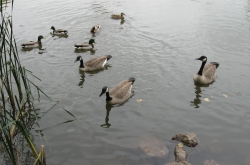
He saw some eagles off in the trees. Geese are stupid and noisy and … well … they make a mess on the sidewalk.
 |
 |
| Can you see the eagles? |
Geese have those useless flat beaks that can only pinch, so they are bullies. Eagles have those sharp beaks and powerful claws (called talons) and powerful wings (called wings), and they don’t bully anyone … because they don’t have to.
Worst of all, geese think they own the world – even more than squirrels do, or cats, for goodness sakes. Eagles … they know. As the geese HWRONKED and HWRANKED and bobbed their heads importantly, one eagle high in the tree looked down at Nicker and nodded. Regal. Like a king – or like a queen, Nicker wasn’t sure at this distance.
“Silly geese,” the eagle seemed to say. “They do not behave properly.”
So Nicker closed his eyes and relaxed again.
The water in the pond was getting more shallow. And then Nicker heard another sound. A machine sound.
Now, as you might know, fish and frogs and turtles and birds and bugs and foxes and bears and loons and raccoons, even eagles, hardly ever work machines (except maybe on Sunday when no one is looking). Nicker peeked up and saw a big machine going slowly across a different kind of pond. It was a big rectangle. It had straight sides. In it were many, many plants. On the plants were many, many berries. Now the berries were floating in the water, and a young red-haired girl was tossing them into the air.

I think I see Nicker. I sure do see the berries
 |
It looked like fun, but … do you remember what happened when Nicker ate the scary-berries? I sure do, and so did Nicker! Besides, the machine was noisy. Even the eagles went off to the high trees to watch from there. Nicker dipped low in the water so only his eyes showed, and those not by much. Ahhh, but people come to work and then they go home. They left the rectangle pond. It was covered with red berries floating in the water. More berries than Nicker had ever seen in his life. Some were white, some were pink – most were a bright red. |
| Nicker saw a red-haired girl throwing red berries |
Nicker just couldn’t help himself. He nibbled on one. It was like nothing he’d ever had before! It was sweet and tart and tangy then sweet again. He tried another nibble.
“Mmmm, good!” he thought, and gobbled a whole berry, then another and another. Soon he was gobbling them down a whole mouthful at a time. (I guess swimming all the way across the Atlantic Ocean, up the Saint Lawrence Seaway, all the way across the Great Lakes, then going nearly halfway into Wisconsin tends to work up a tiny bit of an appetite, don’t you think?)
As the sun came up, Nicker was still eating, but he was chewing slower, like a cat who had too many fish. His tummy was so full! Besides, he heard noises. People were coming. Nicker slid out of that berry bog and back into the pond. As he did, he spotted a young boy, and the young boy spotted Nicker (but only a little). The boy smiled as the 4-wheeler had those “brave geese” scatter noisily. Nicker smiled, too. (So did a dog named Zarco, who was riding along and barking at the geese.)
Silly GEESE. If geese are good for one thing other than messing on the sidewalk, they are good for scattering! At least Nicker thought so.
The little boy was tugging on the grown up’s sleeve, pointing toward Nicker and saying, “Grandpa, Grandpa!” But Grandpa was already too busy to pay attention.
Grandpa looked out at the water. The day before, there had been SO many berries. He shook is head. What could have happened?
“Grandpa,” said Carsten as he tugged again, and pointed again at a smiling Nicker, with cranberry juice on his mouth.
“What happened to the harvest?” Grandpa asked, to no one in particular.
“GRANDPA,” Carsten said again, tugged again, pointed again. Grandpa finally looked, but by then Nicker was gone.
You see, Grandpa is a cranberry farmer … or is “grower” more correct, I can’t remember (ask Marilou, she might know). He turned to his grandson and said, “I just don’t understand, Carsten.” (He said that because Carsten is the name of his grandson.)
“It should have taken at least a week to do the harvest, Carsten,” he said. “We’ll have it done in just two days. What happened to all the cranberries?”
Carsten looked up at his grandfather. What could he say? “Uh, well, Grandpa … you see … uh, … it was this way.”
Carsten knew what happened to make the harvest so small. And I know. And you know. So does Nicker, but no sense asking him. He is sound asleep with a tummy full of cranberries.
The next day, Carsten was out with his Grandma Marilou. (Could that be why we call this the Marilou Marsh?) To her surprise, Carsten suddenly began to hop happily in the cart she was driving. Carsten was waving and smiling and shouting, “HI, NICKER!”
Grandma Marilou looked at him and asked, “Who is Nicker?”
Carsten looked back at Grandma Marilou with a secret smile and said (this time he could say it), “Well, Grandma … uh, … you see … it was this way.”
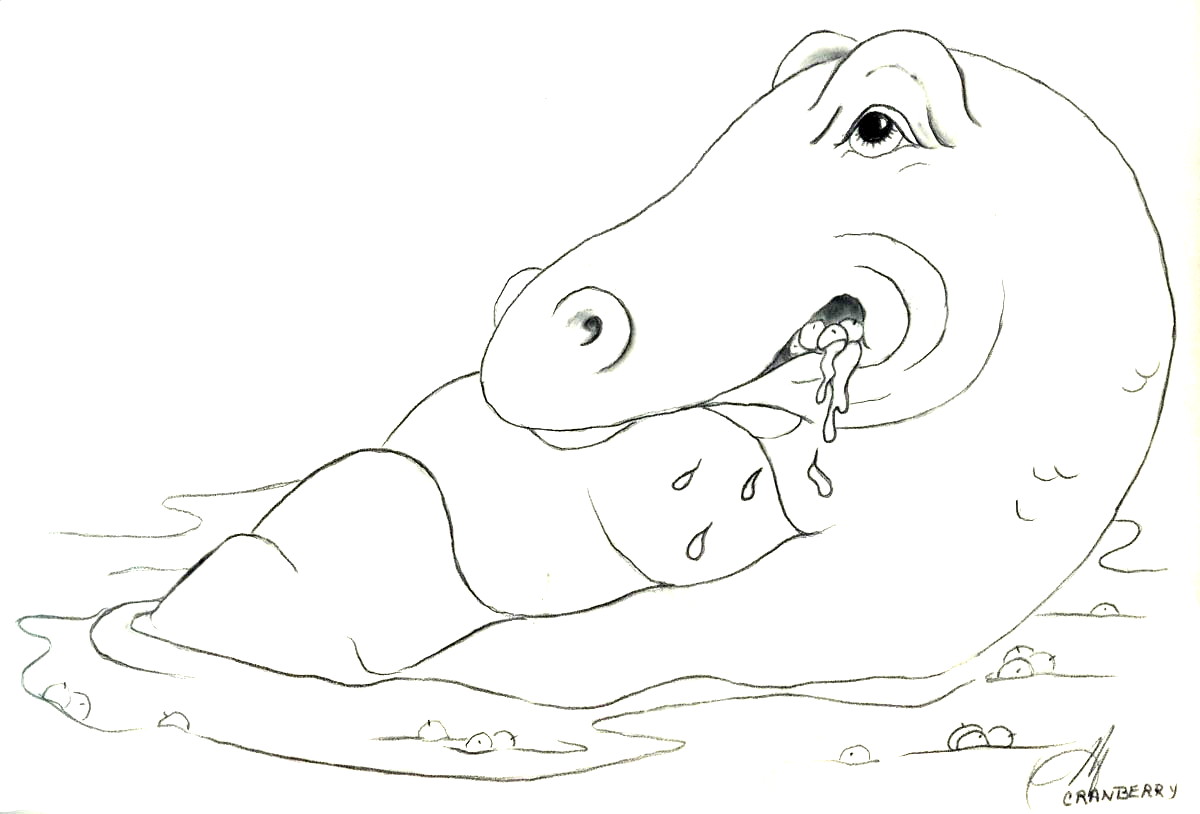 |
Click to enlarge, then color. Enter our contest! Put name and address on the back and send a self-addressed stamped envelope with enough postage to: Nicker Stories 18521 E. Queen Creek Rd. Suite 105, #603 Queen Creek, AZ 85142 |

This is the real Carsten (and the real Zarco)
____________________________________________________________________
____________________________________________________________________
One holiday tradition is the cranberry. It can be served as a sauce, jell, baked into breads and cakes, or even serve as a decoration. It makes a great garland for a Christmas tree, especially when strung with popcorn to get red, white, red, white. When I was a boy, we’d make these, and after Christmas, take all the other decorations off the tree and put it in the yard. The birds, squirrels and other wild animals had their own holiday treat in the Minnesota winter.
The cranberry is an evergreen shrub or vine. It has small leaves. The flowers are pink and have stems that curve downward. They look a little like a crane (the bird). That’s how we get the name – craneberry, which gets shortened to cranberry. In Canada, some call it the mossberry. In England, you might hear of it called a fenberry. This is because it grows in mossy bogs or marshes, called fens.
 |
 |
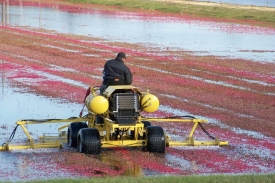
| A machine is used to beat the cranberries so they float in the water | Then they are gathered at one end, washed and taken to a truck |
 |
 |
| Can you imagine standing in that many cranberries? | Here is a truckload of cranberries ready For YOU! (Nicker is resting in the pond) |
Most cranberries are grown in manmade ponds, such as here at Goose Landing (better known as the Marilou Marsh, of course). The berries are white at first, then pink, and in the autumn become bright red. Goose Landing has a natural pond. This is perfect for a tired sea dragon – and to use to flood the cranberries. A machine called a water reel harvester moves through the plants and shakes the berries loose. They float to the surface. Workers can then corral the floating berries in a corner. Here they can be pumped out, with the water returned to the natural pond. (Other places use a conveyor belt instead of a pump. Some growers also “dry harvest.”)
This is usually done in late September and early October. This is why the cranberry is so popular with autumn and early winter holidays, like Thanksgiving and Christmas. Some say that we have traditional colors of red and green for Christmas because Christmas trees are green, and cranberries are red.
 |
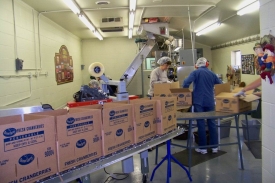 |
| The cranberries get inspected one more time | Then they are boxed and sent out |
Some growers flood the cranberry marshes for winter. Ice forms. You might think that ice is cold. It is. But ice is 32 degrees (0 degrees in the Celsius scale), and that’s pretty much it. If the weather goes way below zero, and a blowing wind makes it even colder … the ice is still 32 degrees. YOU may not like being frozen in ice, but the cranberries love it. It protects them.
Every few years, trucks are driven across the ice to scatter sand. In the spring, the ice melts. The sand mingles in the bed to help with the watering. The cranberries grow. And in the fall, they are harvested again … assuming that a snoopy sea dragon hasn’t eaten them first.
If you cut a cranberry in half, you will see 4 little air pockets inside. This is why cranberries float during the harvest. Guess what else. Those air pockets make the cranberry bounce! At least, good cranberries bounce.
A cranberry grower named John “Peg Leg” Webb is said to be the first to use this to help sort his cranberries. He would harvest the cranberries and store them in the loft of his barn. Instead of carrying them down the stairs, he poured them down. The freshest, firmest berries bounced merrily all the way down. Rotten berries didn’t bounce and stayed on the steps. Today, this idea, called a “bounceboard,” is still used to separate good berries from bad berries.
Most cranberries are used to make juice. It takes 4400 cranberries to make one gallon of juice!
Here are a couple of fun places to visit. And, don’t forget to enter our own coloring contest.
http://www.wiscran.org/user_image/pdf_files/ActivityBook-09.pdf
http://www.cranberryfarmers.org/cranberry_kids.htm
Like this story?
Click here to see previous stories!
