
Story Hour
Outer Space In My Yard
Written by Gene B. Williams
|
Click here for the archive page with a list of previous stories. Please remember that all materials on this website are copyrighted. No reproduction without express permission. |
 |
When you look up into a clear sky at night, you can see many stars and the moon. You might also see a streak of fiery light. This is probably a meteor. Millions of them fall to earth every year. Most are the size of a pebble and end up as burned dust. Only a few ever make it to the ground. |
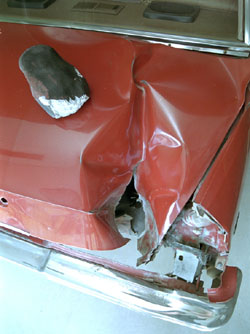
| On October 9, 1992, just before 8 pm, a lot of people in the eastern United States got a treat. One got an unwelcome surprise. A bright streak lit the sky. It moved toward the northeast. Over Kentucky, it began to fall apart. The result was a number of greenish streaks moving together. Finally, the remaining piece of this meteor crashed into a Chevrolet Malibu in Peekskill, New York. Imagine explaining that to the insurance company! It’s not likely that you will ever find a meteorite. Large meteorites are rare. If they’ve been on the ground for long, wind and weather can make them look like “any ol’ rock.” However, your yard, roof, the trees, even you, get covered with meteor dust. Tons of it falls to the ground every year. This is easy to find. |
 |
The simplest way is to drag a strong magnet on a string around in the yard. Most meteors have iron in them and this is picked up by the magnet. You can find even more if you collect rain water from a downspout on your house. The rain washes the air, and also washes your roof. Any container can be used, although a larger container will collect more water, and so more meteor dust.
Let the water settle. A few days or even longer is best. The heavier particles will go to the bottom. Pour the clear water off. You are after the “mud” in the bottom. Let it dry completely, and crush it back into dust. Then move a magnet through it. Again, because most meteors have iron in them, the magnet will pull out the particles.
Not all of it is meteor dust. The air is also full of other kinds of iron, such as from cars driving on the streets. These particles are usually long and thin. Meteor dust tends to be more round. Look at it with a strong magnifying glass. Better yet, use a microscope if you can.
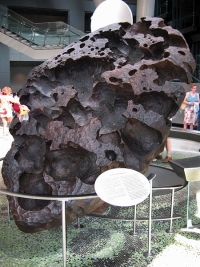
| Imagine that. You have outer space right there in your yard. You’ve been walking on it all this time. The largest meteorite found in the United States, and the sixth largest known, is the Williamette Meteorite. It was found in 1902 in Oregon. Some believe that it fell much farther north and was carried in ice sheets. It weighs more than 15 tons. The markings in the surface were caused by burning as it fell, and also by weathering. |
 |
Like this story?
Click here to see previous stories!
