
Story Hour
Pasty Birthday
Written by Gene B. Williams
|
Click here for the archive page with a list of previous stories. Please remember that all materials on this website are copyrighted. No reproduction without express permission. |
 |
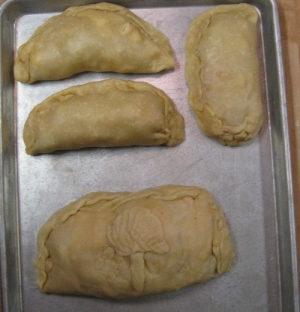 |
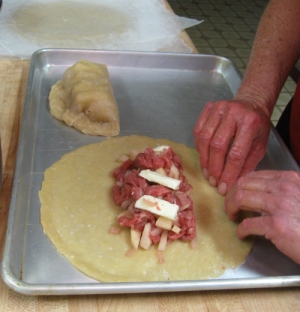
| Stuffing a Cornish pasty, then ready for the oven. The tree is for Treloar, part of my ancestors. You can visit them here or in “Friends of Nicker.” |
|
We have a selection of stories this time. Consider it a birthday menu. “Eat” what you want, come back for more later.
MY Birthday Menu
Often, the birthday boy (or girl) gets to pick what they want for the birthday dinner. What I pick almost every year is Cornish pasties. Have you ever had a Cornish pasty? (It’s pronounced pass-tee.) It’s a special kind of small (usually) meat pie with a big history.
I’ll tell you some stories about them first. Then we get to make them and eat them.
No one knows exactly how they came about. Many countries, and many cultures, have their own kinds. Like the calzone from Italy. Even the “hot pocket” you find in the freezer section of the store is similar.
Well, a little similar, but not really. The idea is the same.
Make some dough and flatten it out into a circle. Put in the stuffing. Fold the dough and crimp the edges to seal everything inside. Bake.
EAT!
http://en.wikipedia.org/wiki/Pasty
Why Pasties?
My grandfather was a miner in Cornwall. Cornwall is a part of Wales, which is a part of England, which is a part of Great Britain, which is a part of the United Kingdom. Can you imagine getting up before the sun gets up, and then going down underground into a deep cave to dig in the rocks? That’s very hard work! It’s not like working at a store or office where you can go outside or a restaurant for lunch. Once you’re down, you’re there. Underground. There is work to do! No time to come out of the mine for a snack, or even to wash your hands.
Have you ever dug a hole? Or used a hammer to chip into a piece of rock? Imagine doing that all day, every day, way down deep underground. You’d get tired, and you’d get very hungry.
So did those Welsh miners. And they got dirty. Even if you haven’t done it, you can imagine it. And imagine this, too. No microwave to warm your lunch, no refrigerator, either. No stove. No restroom.
One of the things they brought with them to eat was the pasty.
A pasty is a meat pie. Sort of. It’s a meal right there in your fingers.
A dough is made with flour. That’s grain, like cereal or bread. The traditional way to make it is with suet. That’s animal fat. It’s high in calories, and that means it gives extra energy for someone who is working very hard. Inside are things like meat and vegetables. In some, there is also fruit. The edge is then folded and crimped.
There are many ways to make a pasty. There are so many ways that ….
I have to tell you a sad story.
Working in the mines is dangerous. If you watch the news, you already know that sometimes a mine collapses. The rocks and dirt fall in. The miners get trapped. I’m sorry to say, sometimes they die. Once they were dug out, one of the ways to identify the bodies was by the pasty they had with them. Each home made them just a little different. The rescuers could use the pasty almost like a driver’s license or other form of ID – or like a sort of fingerprint. The remains of a pasty could be used to identify the person.
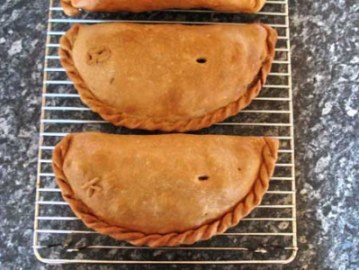
Helping with this, the pasty was often baked with the initials of the person.
 |
 |
| Sometimes pasties were made with “afters.” That means that one end had the meat and potatoes, while the other end had the dessert. The “afters” end was marked with an initial or some other symbol. This also showed whose pasty it was. |
Mining is dirty work and the dirt is sometimes poison. Pasties were wrapped, but even then the miners used that crust as a handle. |
Pasties were usually wrapped in something like wax paper. Even with that, the thick crust on the ends were used as a kind of handle. The pasty could be held by that crust and eaten, then the dirty crust could be thrown away.
This was a good thing because mining is very dirty work. The miners had dirty hands, and often part of that dirt were poisons, like arsenic. The miners could hold the pasty, eat the best part
This was a good thing because of the tommy knockers.
The Tommy Knockers
Deep in the earth are mysterious creatures that no one ever sees. Just how the legend goes depends on where you hear it.
They might be called tommy knockers, or simply knockers. They might be called bucca or pucca or gremlins or … even leprechauns or dwarves or gnomes. Along the shores, fishermen would leave part of their catch. In the fields, farmers would leave part of the harvest. Down in the mines … well, the knockers were different.
Some say that they are the spirits of miners who died in the mines and were still knocking in hopes of being rescued.
“Knock knock knock – come get me out!”
Some say that they are evil creatures, angry about people invading their underground world.
“Knock knock knock – there will be a cave-in and you will die!”
Prevalent (that’s a fancy word for “what you hear most often”) is that the tommy knockers were fun loving. They liked to play jokes. If a miner left a tool, or a pasty, a tommy knocker might sneak in and take it away. Then laugh at the prank. They liked the miners and would warn them of danger.
“Knock knock knock – get to safety, there is danger here.”
The truth is that the walls and ceiling of the mines were held up by what are called shoring timbers. These are a little like the boards that hold up your own walls and ceiling. These timbers creak and moan from all the weight. Sometimes they crack and split. It would be a terrible sound to hear because it could mean that the timber is going to break. If it does, all that ground above can fall in – and if it does, you can be crushed, or at least trapped.
Superstitions, though, are often believed even when the person knows better – as you do now. And sometimes, it is easier – and more fun – to think of mysterious creatures. So, tuck that truth in your pocket for later, and let’s get back to the legends.
In some ways, the knockers are a little like the leprechauns (or gnomes or dwarves). In the Welsh language they were called Bwca or Bucca. Although no one ever saw one, they were said to be about 2 feet tall, but not ugly at all. Just small. They love to live underground, but hate to be seen (and never are). They like to play pranks. If a miner puts down a hammer or pick-ax or other tool, a tommy knocker might take it away to hide it, and then laugh at the joke.
To the miners it was no joke.
You see, the tommy knockers might do two things. If you made them angry, they could take the miners into danger. But, if you kept them happy, they would warn the miners of danger. Many times, the Welsh miners refused to go into a mine until the owner had given some kind of “payment” to be sure that the tommy knockers were there, and happy.
The miners themselves would eat the pasty, and toss the crust off into the dark somewhere so the tommy knockers would have something special to eat.
Treat the tommy knockers right and they will tell you when there is danger.
Treat them wrong and ….
Imagine yourself deep in a mine. You hear a creaking, or worse, a knocking. You know that the tommy knockers are around. Just a little while ago you set down your pick-ax and when you went to get it, it was gone!
The tommy knockers were afoot. Off there in the dark.
But, were they happy? Was the knocking a warning to not go down a particular passage in the cave? Or was it was the sound of the tommy knockers about to bury you alive?
Scary!
Luckily, you have that pasty crust to offer. Give them the end of your meat pie and they might protect you.
The Basic Pasty
There are many ways to make a pasty. Most have sliced or diced steak, sliced onion and sliced potato. The meat is usually beef, but pork, ham or even chicken can be used. Ground meat can be used. For the true Williams version – we use sirloin.
Other ingredients (things you put in) might be a turnip or rutabaga (called a “swede” in Cornwall). Some put in shredded carrot – but there are those who would say that carrot should NEVER go into a Cornish pasty. (I don’t know why – I like it!)
Sometimes the pasty will have fruit inside. This might be as a sauce throughout, or sometimes as a dessert set to one end.
The edges might be crimped with the fingers or with a fork. That way of crimping was another way that Bill’s pasty was different from Greg’s pasty which was different from Yul’s pasty.
No matter what, the basic pasty is a “short” dough (that means it has fat in the dough). This is folded over a filling – usually meat, potatoes and onion – then sealed (crimped) to be baked into a meat pie that can be carried into the mine, hopefully without leaking out all those tasty juices.
Making Cornish Pasties
There are many ways to make a pasty. Here are some places where you can go to learn how. I hope you give it a try, and that you like them as much as I do.
http://thebarefootkitchenwitch.typepad.com
http://www.greenchronicle.com/connies_cornish_kitchen
http://britishfood.about.com/od/england/a/pasty.htm
http://www.suite101.com/content/cornish-pasties
Like this story?
Click here to see previous stories!
