
Story Hour
Shuttle Launch
Written by Gene B. Williams
|
Click here for the archive page with a list of previous stories. Please remember that all materials on this website are copyrighted. No reproduction without express permission. |
 |
 |
Nobody knows when, or even who, first made a rocket. Most believe that it was the Chinese, and thousands of years ago. It wasn’t until about 60 years ago that the idea of a rocket going into space was more than just science fiction. A lot has happened since then.
The first space ships were capsules. Mice, monkeys and dogs were sent up to be sure it was safe for people. For first people also rode in capsules. When they came back to Earth, parachutes opened to slow them, then they splashed into the ocean. It was still a rough landing, but the water was more soft than the land. People got good enough that the “splash down” was accurate to within a few miles. A big inner tube would inflate to keep the capsule from sinking while ships and helicopters got to the astronauts.
Meanwhile, a lot of work went into making better airplanes. It might seem like long, long ago, but … not so very long ago, if you wanted to travel from (say) Minnesota to Arizona (as I did) … if you were lucky you had a horse. Otherwise you walked. It would take months – and no store with cold soft drinks or chips. No McDonald’s.
Then a powered airplane was built. It flew a few feet off the ground for about 100 feet. Then it pretty much crashed. Cars came along, and trains. Then airplanes became safer, and faster. Now you can fly across the country, or even across the ocean, in a few hours.
A special plane called the X-15 was developed. It had wings. That meant it could go up, and it could land at an airport – not just fall into the ocean to be rescued. From this came the shuttle.
There were six.
The first was the Enterprise. It was never meant to go into orbit. The goal was to simply test the idea. It worked. Things went very well until 1986. Challenger blew up 73 seconds after take-off. In 2003, Columbia lost some of the heat tiles and burned up on re-entry.
Endeavour made a perfect launch and landing. Depending on when you read this, Atlantis might be over your head right now – or might be in a California museum.
 |
|
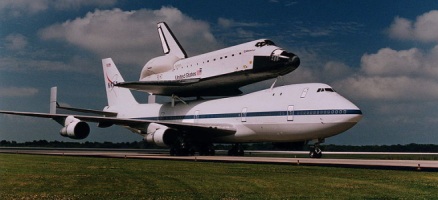

Did you know that the space shuttle can’t fly? At least not like an airplane. They were built, and rebuilt after each mission, in California. They launched into space from Florida. Well, the shuttle can’t fly, so it rode on the back of a 747.
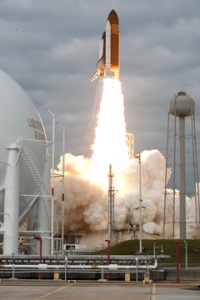
Two large rockets start lifting it off the ground. These come off after about 2 minutes. They fall back into the ocean where they can be recovered and made into rockets for the next mission.
A huge fuel tank begins to burn what it has. Near orbit, it’s empty and falls off. The shuttle is then on its own. It is now going more than 17,000 miles per hour. This is nearly 8 miles per second – faster than a bullet. Imagine being an astronaut inside!
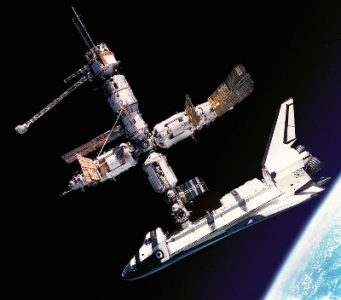
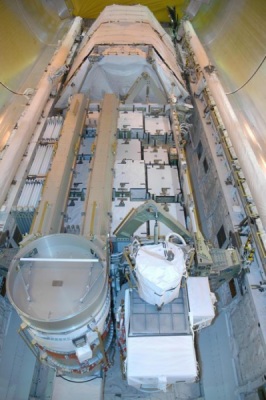
Next, it has to find where it is going. It might be putting another satellite in orbit, or might be fixing one that is already there. It might be going to the Hubble space telescope, or might be hooking up to a space station.
Have you ever tried to thread a needle? Imagine doing this when the thread, the needle and everything is moving around – and YOU have the feeling of being in a very fast elevator. This is called “free fall.” The gravity of Earth is pulling you down. You’re falling. But at the same time you are going so fast that you don’t fall. You feel like you are floating – and you are. So is everything around you.
Out there, somewhere, is the place you want to go. It’s like trying to find a particular ball floating in a huge swimming pool, but it’s moving, too – faster than a bullet. You have to find it, catch up to it, slow down to it – not crash into it!
There is no air. Thank goodness there is no air! If there was, you’d melt! You’d burn up.
You’ve spent many years learning how to do this, though.
Now it is time to come home.
VERY carefully you separate from the space station. It’s not like coming out of a parking spot. You can’t just back out. Everything is in motion – faster than a speeding bullet. When you back away from a store, the store stays right where it is. In space, when you back away, that makes the store back away. You move, and IT moves because you’ve moved.
It gets tricky!
Then it’s time to come home. To do that is fairly simple. Just slow down. If you are in orbit and slow down … you fall. Now comes an interesting problem. You’ve been traveling at more than 17,000 miles per hour. You have to slow down - A LOT - but there are no brakes. Not really.
So, you use the air. You use friction.
Wave your hand. You can feel the air. So can a space ship coming back to Earth. It’s like a rock falling into a pond. The rock slows down. The shuttle is going so fast, though, it gets hot. It becomes like a “falling star.”
If you come down too fast, you’ll burn up – just like a meteorite. If come down too slow, you’ll bounce off – just like a rock can bounce off the water.
An airplane uses it engines or jets to slow down. A shuttle doesn’t have these. When an airplane lands, it has it propellers or jets to drive it to the gate. A shuttle doesn’t have these. It has to be towed, but first it has to cool down. It’s red hot!
 |
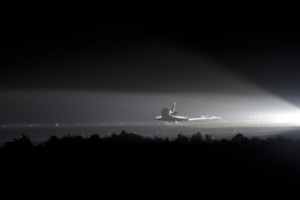 |
Once the shuttle gets back, is towed, checked over, it gets mounted to another 747 for another cross-country trip.
Endeavour is
|
 |
 |
 |
Skylab was launched in 1973. This was the first major space station. In 1979 it slowed, and it fell, and it busted up and burned up. Most of it fell into the ocean. Some pieces fell on Australia. |
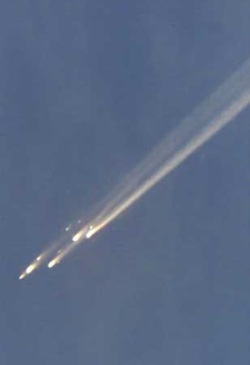 |
burned up. All of it fell into the South Pacific. |
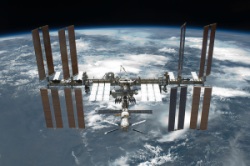
to build the station. It’s now large enough that you can see it just with your eyes. The first link will tell you more about the space station. The second link will tell you how to see it go across your own backyard. (It circles the Earth just about 16 times each day.)
http://www.nasa.gov/mission_pages/station/main/index.html
http://spaceflight.nasa.gov/realdata/sightings/index.html
The shuttle is retired. There will never be another, except in a museum. The people on the station still need groceries and other supplies. Soyuz will take care of most of this. (In space, you can’t go to the McDonald’s on the corner. You can’t even go the park drinking fountain.)
Plans are being made for new space ships. Plans are also being made to land on the moon again, and even to travel to Mars.
|
Like this story? |
